Specific scenarios · Ages 2–4
Toddler Bedtime Tantrum Scripts: What to Say When the Room Gets Loud
Three calm scripts for toddler bedtime meltdowns — what to say when 'one more story' becomes a 30-minute fight. Lines you can practice tonight.
By Andrey Soloviev · Founder of Voiced. Co-founder of Mom.life and BabyBlog.
Published · 7 min read
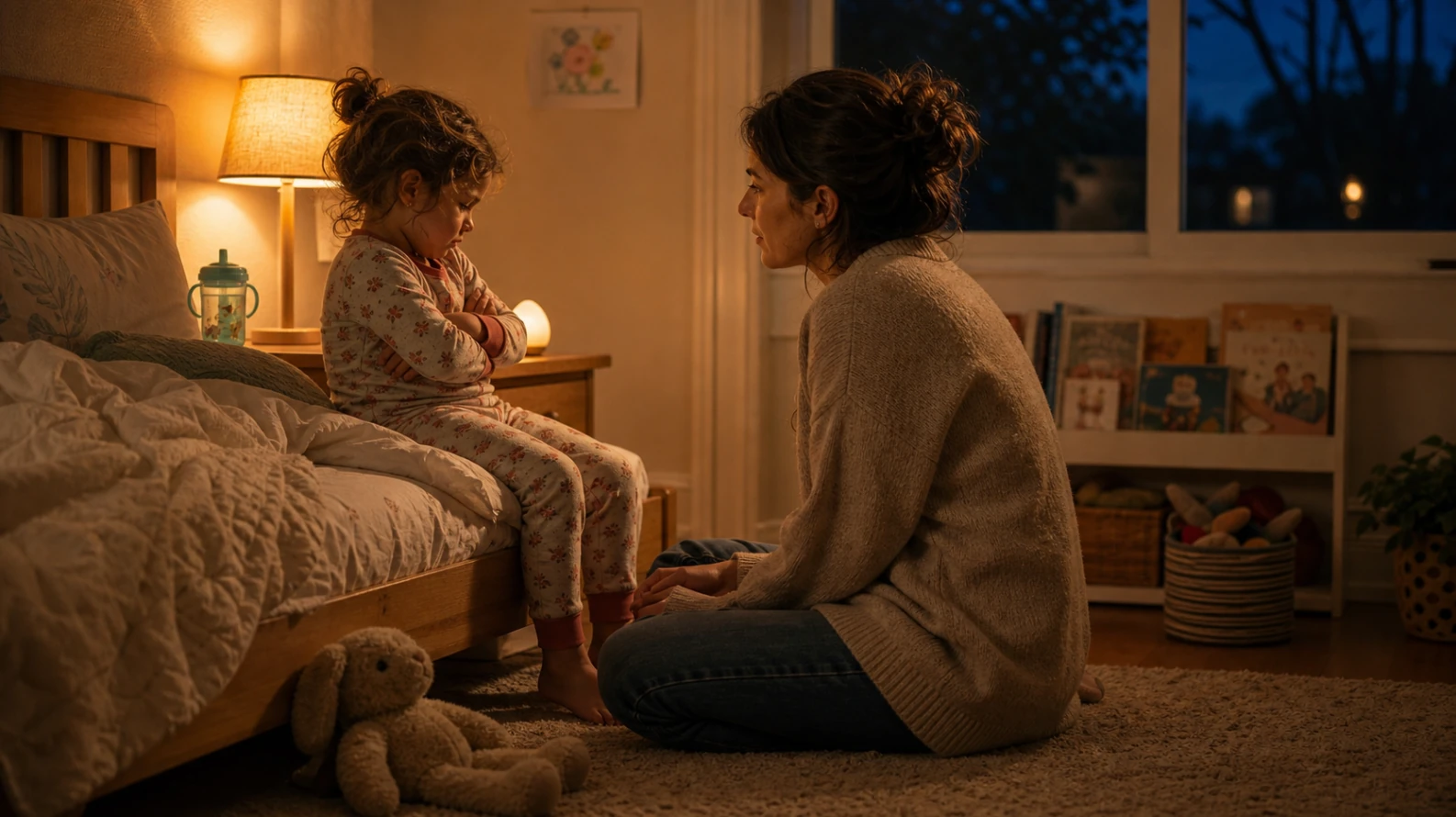
It’s 7:47 PM. The brush is in the cup, the lights are dim, the same book is on the shelf as last night. And your three-year-old is on the rug, body stiff, voice rising: “I’m NOT going to bed.” You take a breath. You try the line you’ve been telling yourself you’d use. It comes out sharper than you meant. Within forty seconds you’re both shouting and one of you ends up apologizing in the dark.
If that sounds familiar, you are in the right place. Bedtime is one of the most consistently hard parenting moments for toddlers — and one of the most rehearsable. The first sentence you say when your toddler pushes back is the sentence that decides whether the next twenty minutes are connection or escalation. Below are three short scripts to try, the developmental reason each one tends to land, and the words to avoid that make things worse without us realizing.
Why toddlers melt down at bedtime (even when they were fine all day)
By the end of the day, a toddler’s nervous system is essentially out of capacity. The American Academy of Pediatrics notes that children aged 1–2 need 11–14 hours of sleep per 24 hours, and 3–5-year-olds need 10–13 hours — and that a fragile, depleted state at bedtime is normal, not defiant. The prefrontal cortex, the part of the brain responsible for impulse control and language-based regulation, is barely online at this age and even less online by 7 PM.
What looks like a power struggle is usually a regulation crash. Your toddler is not strategically holding out for more screen time. They’re a small person whose brain has run out of the wiring needed to handle one more transition. That’s why the same kid who happily said “okay” at 4 PM is now lying face-down on the floor at 8 PM about which pajamas to wear.
This matters for what you say next. Logic doesn’t reach a flooded toddler brain. Co-regulation — your calmer nervous system lending stability to theirs — does. The scripts below are designed to lend regulation first and ask for cooperation second.
What not to say (and why it backfires)
Three common lines that almost always escalate a toddler bedtime tantrum:
- “You’re being ridiculous.” Names the feeling as wrong. A flooded toddler can’t process the word “ridiculous” but absolutely hears the tone: my parent thinks something is wrong with me. Adds shame to dysregulation.
- “I’m going to count to three…” Adds time pressure to a brain that is already overwhelmed. Often forces parents into a corner where the count ends in a punishment they didn’t actually plan, which then becomes the new normal.
- “If you don’t get in bed, no story tomorrow.” A consequence delivered mid-meltdown almost never registers as cause-and-effect for a toddler. It registers as a parent who is upset. It also stacks anticipatory dread onto tomorrow.
None of these lines mean you are a bad parent. They are short, automatic, and learned. The whole point of practicing a different first sentence is that the automatic one is hard to override in the moment — you need a new sentence ready before the moment arrives.
Three calm scripts you can practice tonight
Each script is short, deliberately under fifteen words, and built around a single principle: name what’s true, hold the limit, stay close. Read them out loud once now. The muscle memory of having said them helps you find them later.
Script 1 · The reset
Use when your toddler is already crying and the room is loud.
Toddler: "I'm NOT going to bed! I want Daddy! I want a snack! I want to watch the show!"
You: "Bedtime is hard tonight. I'm right here. We can sit on the rug for a minute."
Why it works: Names the difficulty (your toddler feels seen), holds the frame (it's still bedtime), and offers a small co-regulation step (sit on the rug) that doesn't move the goalposts.
Script 2 · The narrow choice
Use when your toddler is stalling — "one more story", "one more drink", "one more song."
Toddler: "One more book! Just ONE more book!"
You: "We can do one short book or two songs. You pick."
Why it works: Gives your toddler a real choice between two things you can live with, instead of a yes/no fight. Restores some agency without negotiating the actual limit (bedtime is still happening in the next five minutes).
Script 3 · The exit line
Use when you've been in the room for fifteen minutes and your toddler keeps re-engaging.
Toddler: "Stay! Don't go! I need water! Lie down with me!"
You: "I'm going to sit by the door for two minutes. Then it's time to close my eyes too."
Why it works: Signals a clear, time-bounded transition without abandonment. Says *I am leaving in a way you can track*, which is much easier for a toddler nervous system than a sudden exit or another full-volume conversation.
Practice this conversation in 2 minutes
Reading a script is not the same as being able to say it when your three-year-old is wailing about a pajama tag. The reason most parents already know the right words but say the wrong ones is that bedtime is the worst possible time to be trying a sentence for the first time.
Voiced is a small private app for that. You take a two-minute quiz, the AI picks the scenario closest to your night (toddler bedtime, screens, homework, backtalk), and you rehearse the first sentence against pushback that sounds like a real kid. By the time the real moment shows up, you’ve already heard the line in your own voice once. That’s the whole pitch — reps for the moment, before the room gets loud.
Related parenting moments
The same calm-first-sentence pattern shows up in other moments:
calm scripts for screen-time tantrums
Three calm scripts when the screen-time timer goes off and your 5-7-year-old melts down — the developmental why, the line to skip, and what to try tonight.
Read →
calm scripts for teen backtalk
Three calm scripts for when your teenager shuts you down or talks back — the developmental why, the line to skip, and what to say when 'whatever' lands.
Read →
calm scripts for 8yo homework refusal
Three calm scripts for when your 8-year-old keeps avoiding homework — the developmental reason it spikes, the line to skip, and what to say tonight.
Read →
Questions parents ask first
Why does my toddler tantrum at bedtime when they were fine all day?
Toddlers run out of regulation capacity by the end of the day. Their prefrontal cortex — the part of the brain that helps with self-control — is still developing, and after a full day of new experiences, it's depleted. Bedtime resistance is rarely about bedtime itself. It's about a tired brain that no longer has the energy to handle a transition or a 'no'.
Should I let my toddler "cry it out" at bedtime?
There is no single answer that fits all families. Different evidence-based approaches range from extinction methods to gradual responsive settling. What the research is clear about: consistency matters more than the specific method, and persistent severe distress should be discussed with your pediatrician. The scripts in this article are about staying calm during the transition, not about whether to respond to crying.
What if my calm script still results in a meltdown?
It often will, at least the first few times. The goal of a calm script is not to prevent the tantrum — it's to keep you regulated through it so you don't add fuel. A meltdown that ends in connection ('I stayed with you until you settled') reinforces a different pattern than one that ends in shouting. Both can include tears.
When should I talk to a pediatrician about bedtime resistance?
If bedtime resistance is paired with frequent night waking that is hurting your child's daytime mood, growth, or learning, or if your toddler shows persistent fear at bedtime that doesn't respond to reassurance, talk to your pediatrician. Sleep problems can be linked to other issues — sleep apnea, anxiety, sensory processing — that need professional input.
How is practicing a script different from just reading parenting advice?
Most parents already know what they want to say. The hard part is getting the words out when your child is mid-meltdown and your own nervous system is firing. Practicing the line — even just saying it out loud once before bedtime — makes it easier to access in the moment, because you've literally rehearsed the muscle memory of saying it calmly.
Sources and further reading
- American Academy of Pediatrics. Healthy Sleep Habits: How Many Hours Does Your Child Need?
- Child Mind Institute. How Can We Help Kids With Self-Regulation?
- Zero to Three. Toddler sleep: what to expect